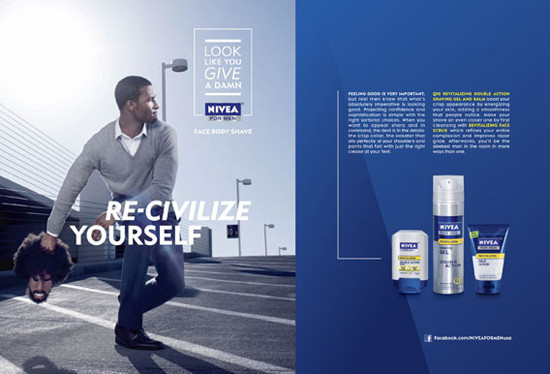
Arguably one of the most controversial industries, Advertising has drawn a lot of criticism for its use of inappropriate even racist stereotypes. Ads like NIVEA's 'Look Like You Give a Damn' campaign have caused outrage for their apparent racism. Featuring a clean-shaven African American man throwing away a mask of a 'caveman' unshaven version of himself, the ad has been interpreted to imply that his natural/ethnic hair is somehow uncivilized.
Similarly, American Apparel featured an ad on their website of a model holding onto a Hispanic farmer which drew outrage from the Hispanic American community for stereotyping Hispanic American farmers.

One justification for the use of racial stereotypes is illustrated in Erving Goffman's concept of "commercial realism" in which Advertising presents the advertising world in a way that is consistent with the real world. In a way, the claim suggests that advertisements are a mirror reflecting back the realities of society - both the good and the bad. By employing the use of stereotypes, the advertiser can communicate implicit meaning to the consumer simply and quickly. While this in no way justifies the commodification of racial stereotypes, could it then be suggested that advertisements are seen as racist because we as a society are racist?
In the past few years, we have found a myriad of advertisements that seek to defy traditional concepts of race. And rather than being celebrated, these ads have received a shocking racial backlash. Cheerios released a 30-second ad featuring a mix-raced girl "Gracie".
Both heartwarming and forward-thinking, the ad elicited inappropriate and racist comments on YouTube, expressing "shock" that the 'black' father has stayed with the family, or disdain upon finding out the mother is 'white'. While there were also comments expressing grattitude to Cheerios for featuring a biracial family, the shocking response from many viewers suggest that even when an advertisement attempts to portray a stereotype that is not in-line with what is perceived as the "norm" for many individuals, there is a backlash.
This was also the case more recently in the 2014 Coca-Cola Superbowl ad "America is Beautiful".In the ad, various Americans from a myriad of ethnic backgrounds sing the patriotic song "America the Beautiful" in their native tongues.
While it was meant to celebrate the "multi-racial" melting pot of America (the country of immigrants), many Twitter and Facebook commenters expressed disdain calling the ad "unpatrioic", "disgraceful", even suggesting immigrants "speak English or go home". The ad challenges the conventional image of an American as a "monolingual" Caucasian. And in defying that stereotype and producing an image of the American society as multi-racial, the ad faced backlash. If advertisements are a mirror of society, both through employing inappropriate racial stereotypes and embracing cultural diversity in a society, what does that say about us as a society? And more importantly, what do our reactions and interpretations of these ads say about us?


No comments:
Post a Comment